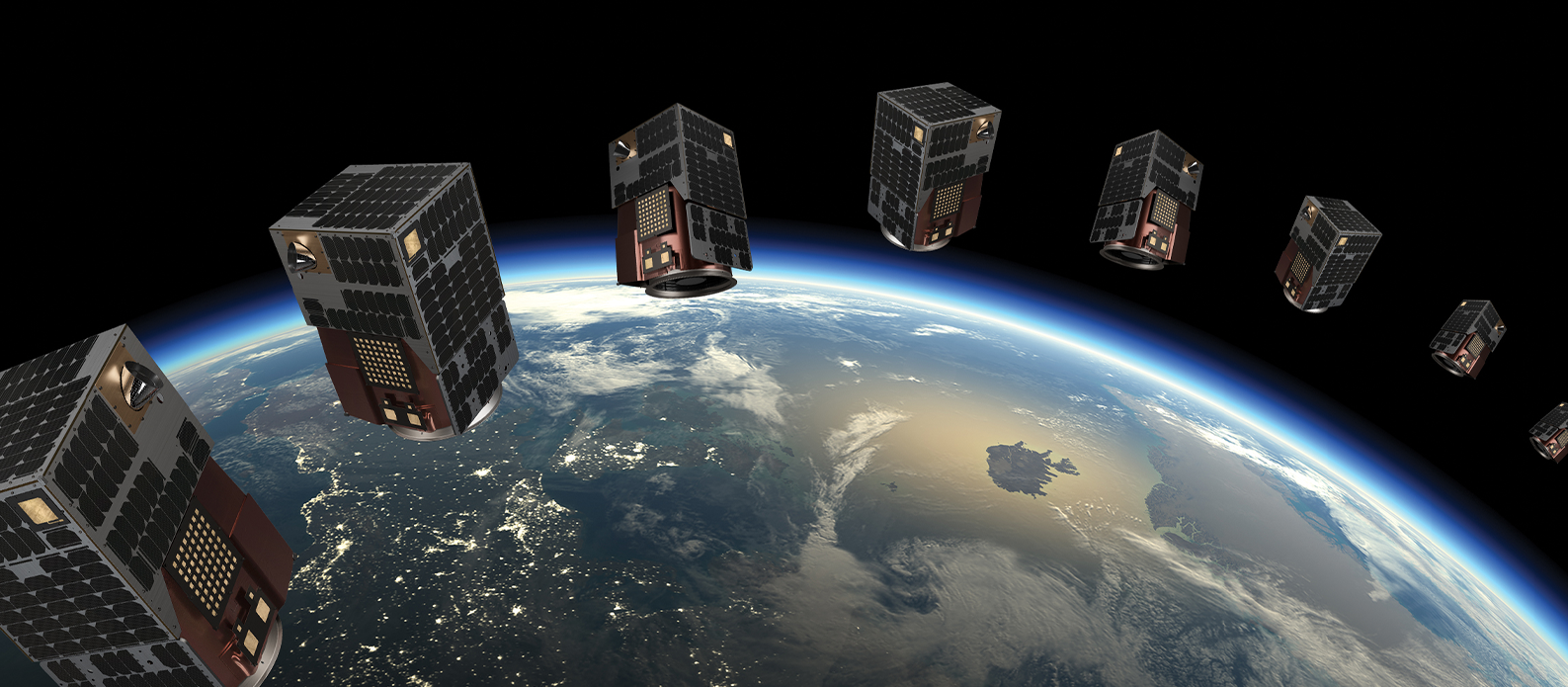
The Demand for Persistent Monitoring at Scale
By The Satellogic Team
Move beyond reactive tasking. Persistent Earth Observation delivers daily visibility and historical context needed for superior geospatial intelligence.
The shortcomings of conventional, task-based observation aren’t always obvious. That doesn’t mean they don’t exist. And what isn’t seen can determine whether a mission succeeds or fails.
Through longstanding partnerships with defense and intelligence organizations globally, one operational reality has become increasingly clear: sustaining reliable visibility across expanding areas of interest is no longer practical under a purely reactive collection model.
Collection requests go unfulfilled.
Tasks are reprioritized as new events emerge.
Revisit windows stretch precisely when activity begins to accelerate.
Individually, these constraints are manageable. Collectively, they create gaps — often in the locations where early awareness matters most.
At the same time, monitoring scope has expanded dramatically. Many organizations are now responsible not for a handful of sites, but for hundreds or thousands across multiple regions. In many cases, persistent awareness is no longer optional, it is an expected baseline requirement.
This shift is reflected in procurement behavior. Increasingly, defense and intelligence buyers are not purchasing imagery as isolated collections. They are structuring monitoring programs, sustained coverage models designed to scale across broad areas of interest.
With that evolution comes a corresponding expectation for providers: assured capacity, scalable coverage, and availability that does not collapse under surge demand.
Why Reactive Tasking Is No Longer Enough
The shift underway is not simply about technology. It is about scale.
Monitoring a handful of locations can be managed through deliberate tasking. Monitoring entire countries or continental theaters requires a different model. At that scale, the risk is not slow collection. It is incomplete awareness.
Reactive tasking assumes teams can anticipate where and when activity will occur. In practice, meaningful developments rarely begin as clear events. They emerge incrementally — phased construction, gradual staging, subtle shifts in utilization that only become significant over time.
When coverage depends on triggering collection after suspicion arises, organizations face an operational burden:
- Deciding what to task — and what not to
- Reprioritizing as new developments compete for attention
- Managing access in high-demand regions
- Reconstructing context after activity has progressed
At national or continental scale, this approach becomes increasingly difficult to sustain — particularly as monitoring expands across hundreds or thousands of sites.
The requirement is not simply faster tasking. It is continuous awareness across all priority locations.
Tasking remains valuable for targeted needs. But alone, it was never designed to operationalize always-on monitoring at this scale.
What Buyers Are Seeking Instead
In response, defense and intelligence organizations are increasingly procuring structured monitoring programs built around coverage footprint and assured capacity.
The requirement is straightforward: the ability to monitor all priority sites across large regions — not just selected locations — without having to decide each day where to look next.
Buyers are seeking models that provide:
- Assured capacity across broad geographic areas
- The ability to scale from tens of sites to hundreds or thousands
- High-quality imagery delivered consistently across the full monitoring footprint
- Availability that holds even during surge demand.
The objective is not exquisite collection on request. It is comprehensive visibility.
When capacity is secured across an entire region, monitoring becomes operationally manageable. Change surfaces wherever it begins, not only where attention was directed.
The shift is subtle but decisive: from choosing what to watch, to knowing that everything within scope is being watched.
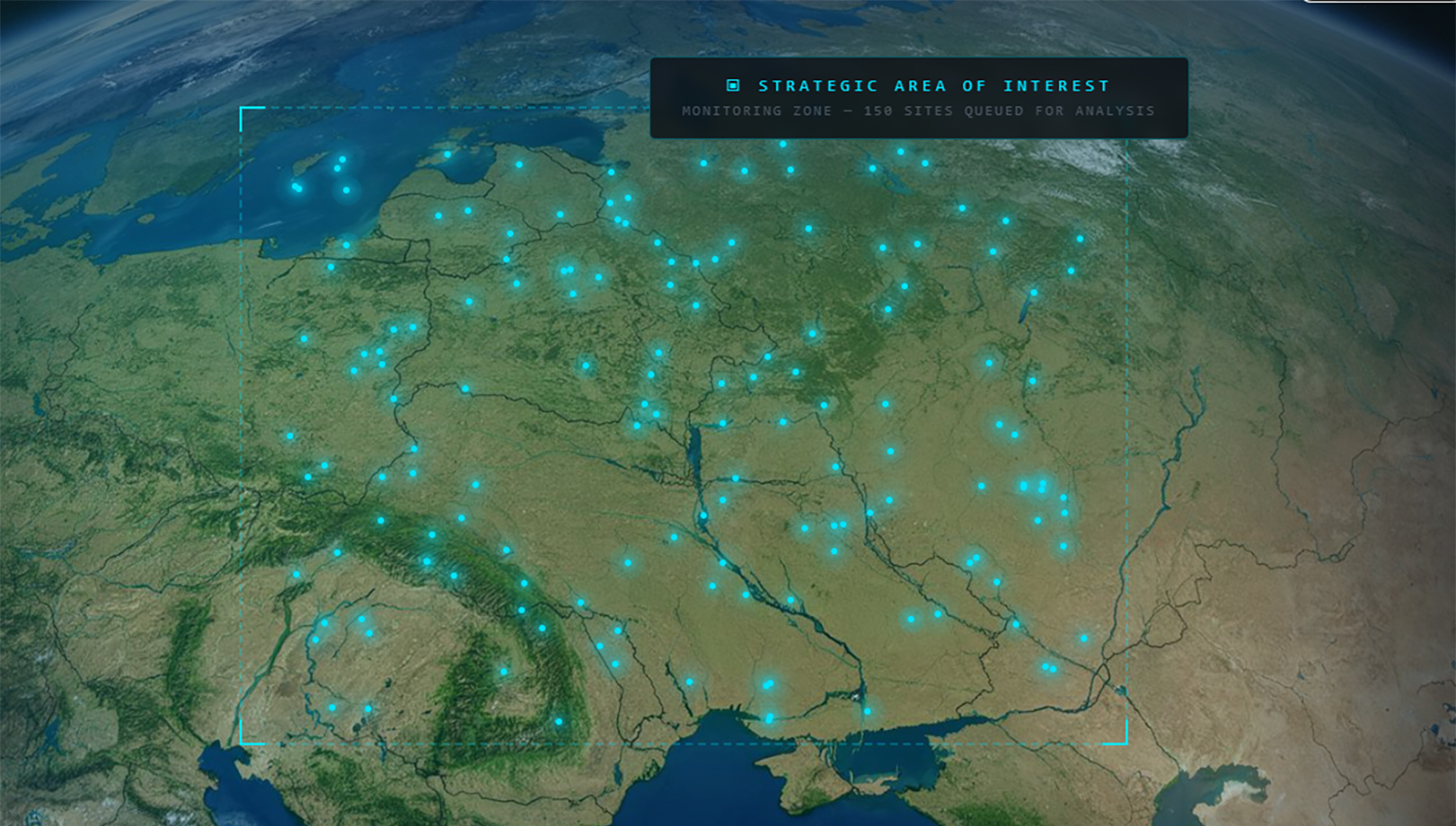
Persistent monitoring across a strategic area of interest, enabling continuous visibility over hundreds of priority sites simultaneously
Monitoring Entire Regions, Not Isolated Sites
The value of persistent coverage compounds when applied across full theaters of interest.
It is not simply about watching a port. It is about monitoring all major ports across a coastline simultaneously.
Not tracking a single vessel. Tracking maritime movement patterns across an entire region.
Not revisiting one airbase. Maintaining visibility across every airfield within a theater.
This regional model supports:
- Maritime domain awareness: Continuous observation of port utilization and vessel behavior across territorial waters.
- Infrastructure surveillance: Persistent coverage of development activity across distributed facilities and strategic zones.
- Border and remote-region monitoring: Visibility into staging and corridor formation across wide geographic frontiers.
- Force posture awareness: Monitoring activity patterns across multiple bases and operational nodes in parallel.
Across these mission areas, the differentiator is scale. Comprehensive visibility across the full footprint reduces blind spots that emerge when monitoring is selective.
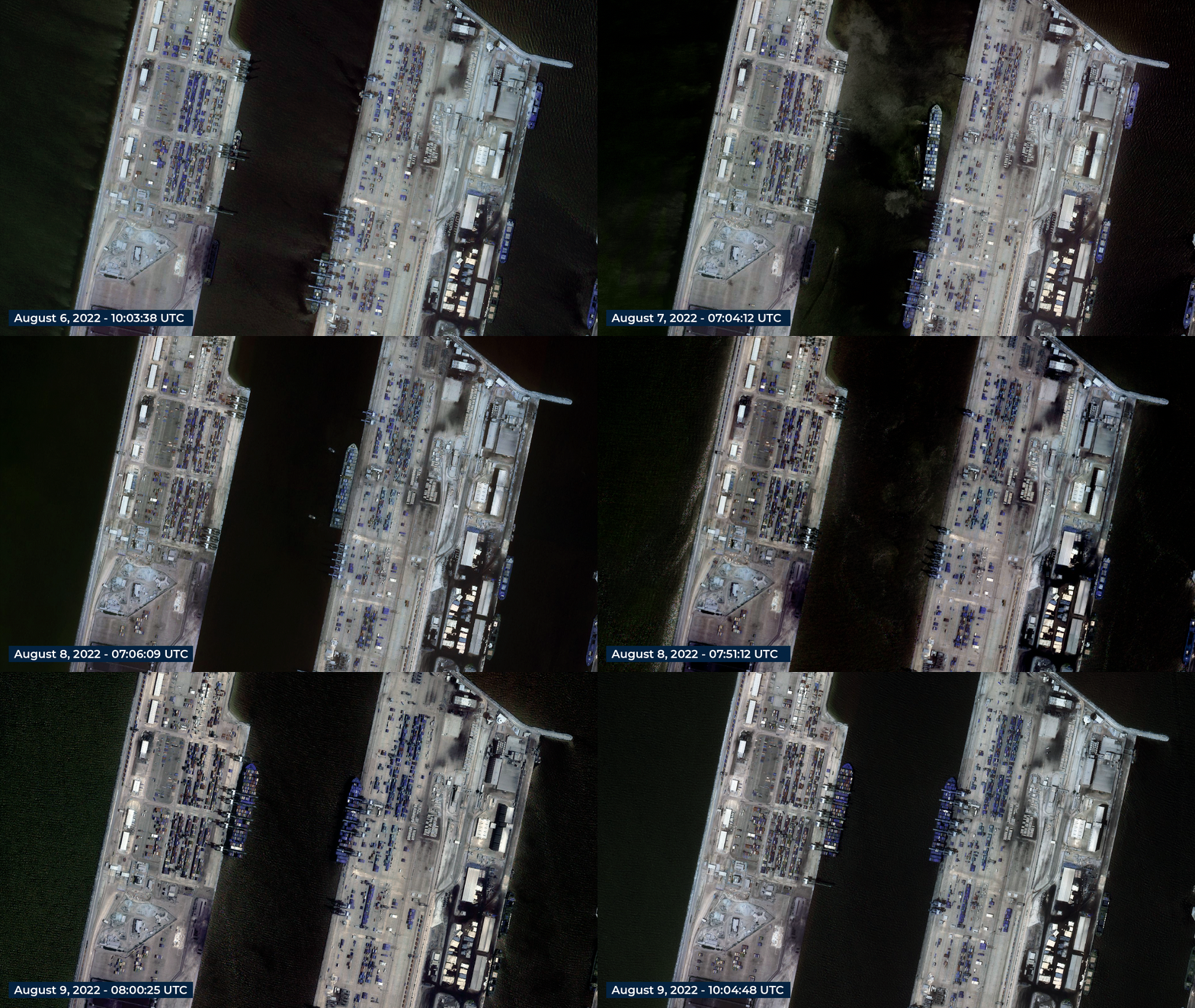
Time-lapse visualization of persistent earth observation showing continuous monitoring of a maritime port.
Persistent Coverage as Strategic Infrastructure
As monitoring responsibilities expand geographically and numerically, imagery must function as infrastructure.
Persistent Earth Observation provides:
- Assured collection capacity
- Scalable coverage across extensive areas of interest
- Reliable delivery even in high-demand environments
Visibility secured in advance fundamentally changes operational posture. It reduces competition for access, stabilizes monitoring programs, and supports always-on awareness across all priority sites.
In surge conditions, the distinction becomes clear:
Some organizations compete for collection when events escalate.
Others already have continuous visibility in place.
If your areas of interest are expanding, or your monitoring requirements are moving toward theater-scale oversight, it may be time to evaluate whether your current model is structured for scale.
Contact us to learn more about our Persistent Earth Observation offerings.